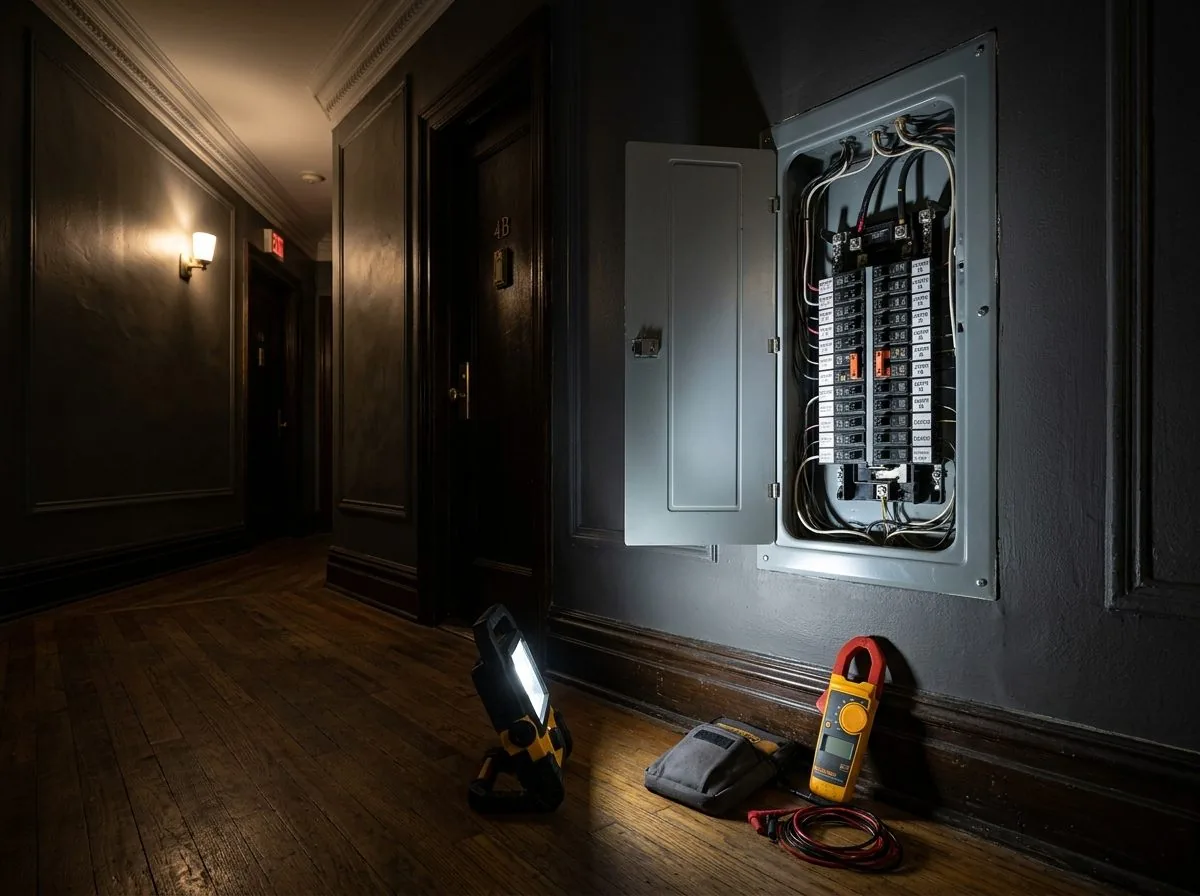
When the lights suddenly go out in your Upper West Side apartment, the cause could be a tripped breaker inside your hallway closet, a blown feeder fuse in the building basement, or a street grid problem affecting several blocks. Following a calm, step by step check tells you right away who to call and keeps your appliances safe. This guide is part of our Upper West Side Home Electrical Guide.
Step 1: Check If the Outage Is Just Your Apartment or the Whole Building
Before touching your breaker panel, walk to your front door and look at the public hallway lights and elevator indicators, or call down to your doorman or neighbor:
- Hallways and Neighboring Buildings Are Dark: This is a utility street grid outage. Report the outage on the Con Edison outage map and unplug high draw appliances so they do not surge when street power returns.
- Hallways Are Lit, But Your Entire Apartment Is Dark: The problem is isolated to your unit. Either your main apartment breaker tripped, or your apartment feeder fuse in the locked basement meter room blew.
- Half of Your Apartment Works, Half Is Dead: Most Manhattan apartments receive two hot legs of 120 volts from the basement. If one of the two basement cartridge fuses blows, half of your circuits stay on while the other half go completely dead.
Step 2: Inspect Your Apartment Breaker Panel Safely
Take a flashlight to your apartment breaker box and open the metal door. Stand to the side and look and smell before touching any switches. If you notice a sharp fishy or burning plastic odor, black soot, or heat radiating from the cover, do not touch the breakers. Call our 24/7 emergency electrical dispatch line immediately.
If the panel is cool and odorless, look for a breaker handle that sits in the middle tripped position between ON and OFF. To reset a tripped breaker, first unplug the air conditioner, space heater, or kitchen appliance that was running on that circuit. Then push the breaker handle firmly all the way to the OFF position until it clicks, and flip it back to ON.
Step 3: What to Do During a Summer Con Edison Brownout
During severe July and August heat waves, peak air conditioning demand across Manhattan sometimes forces the utility to reduce voltage by 5 or 8 percent while repairs are made on underground cables. Low voltage is hard on motor driven appliances.
If your incandescent or LED lights dim noticeably across the entire building and utility alerts report a voltage reduction in your ZIP code, turn off window air conditioners, washing machines, and microwaves immediately. Running a compressor motor on low voltage causes the motor windings to draw extra current and overheat.
Warning Signs That Require an Emergency Electrician
Never try to reset a breaker or replace a fuse if you observe any of these active electrical hazards inside your apartment or brownstone:
- Water dripping from an upstairs leak into your breaker box, ceiling light fixture, or bathroom fan.
- Lights in one room turning unusually bright while lights in another room go dim, which signals a dangerous loose neutral connection.
- Audible buzzing, sizzling, or crackling sounds inside a wall switch or panel enclosure.
- A breaker that snaps back to the tripped position with a flash or pop the instant you reset it.
Preparing Your Home for Future Outages
As detailed in emergency preparedness guidance from Ready.gov, every apartment should keep flashlights, spare batteries, and a charged phone power bank in an easy to reach drawer. For homeowners who need continuous backup power for medical devices, refrigeration, or home offices without violating NYC apartment fire codes, we install silent indoor battery backup systems through our battery backup and generator installation service.
Lost Power in Part or All of Your Apartment Right Now?
Our licensed Upper West Side electricians are available 24/7 to trace blown basement feeder fuses, short circuits, and panel failures.
Go to 24/7 Emergency Electrical Service or call PeakPower Upper West Side at (212) 555-0123.
Frequently Asked Question
Your apartment panel is fed from the basement meter room by two separate 120 volt hot legs, each protected by its own main fuse or breaker in the cellar. When one of those two basement fuses blows, every other row of breakers in your apartment loses power even though the breaker switches upstairs look normal.
Related Upper West Side Electrical Guides
Upper West Side Home Electrical Guide
Read our complete master guide to apartment electrical systems on the UWS.
Read ArticleWhy Breakers Trip in Old Apartments
Learn why summer air conditioners and shared circuits trip apartment breakers.
Read ArticleEV Charging in NYC Co-ops: Board Approval Guide
See how battery backup and energy management work in Manhattan buildings.
Read Article