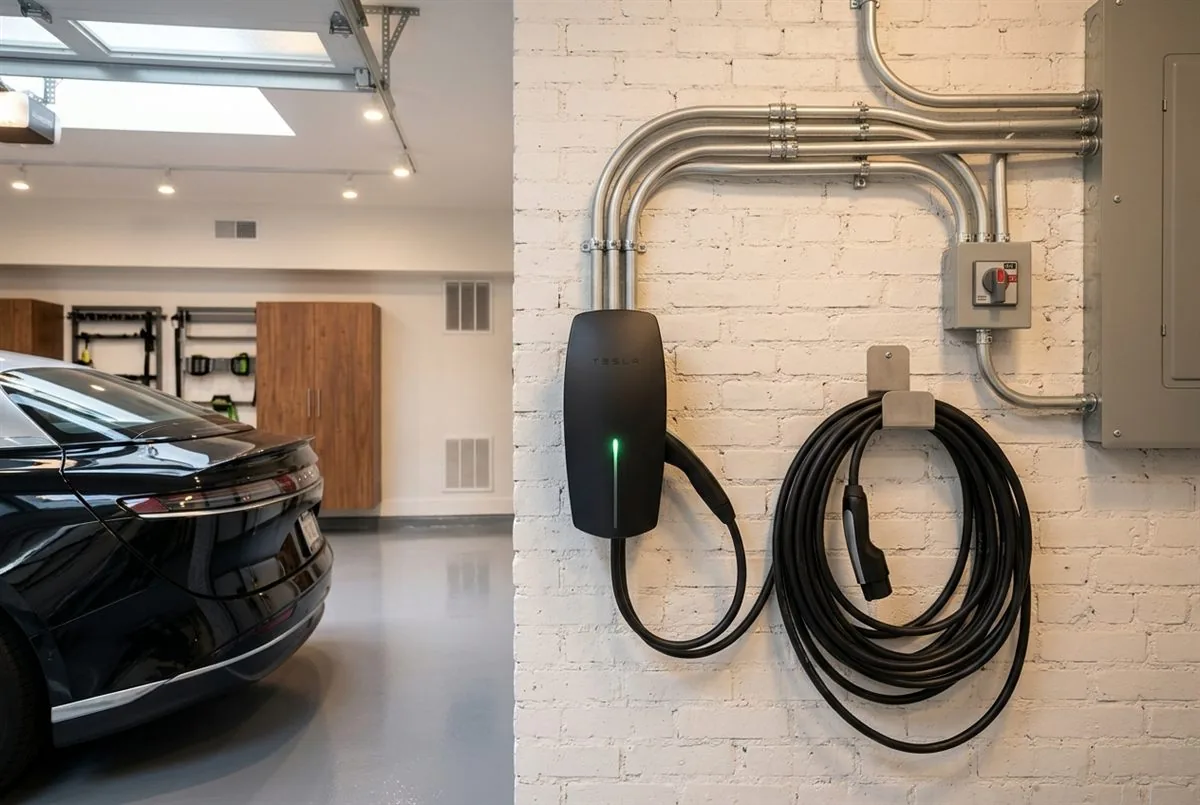
Buying an electric vehicle when you live on the Upper West Side brings up an immediate question. Where and how will you charge it? If you own a private brownstone with a curb cut or garage, wiring a charger is straightforward. If you park in a cooperative or condominium garage along Riverside Boulevard or Lincoln Square, getting board approval requires a clear technical plan. This guide is part of our Upper West Side Home Electrical Guide.
Level 1 vs Level 2 Charging in a Manhattan Garage
Home EV charging falls into two speed tiers based on voltage:
- Level 1 Charging (120 Volts): Plugs into a standard 15 amp or 20 amp wall outlet. It adds only 3 to 4 miles of driving range per hour. A full recharge from an empty battery takes two to three days.
- Level 2 Charging (208 or 240 Volts): Runs on a dedicated two pole circuit between 30 amps and 60 amps. Even on a 208 volt NYC commercial garage panel, a Level 2 station adds 20 to 35 miles of range per hour, charging any EV overnight.
What Co-op and Condo Boards Ask For Before Approving a Charger
Co-op and condo boards rarely say no to an EV charger because of the car itself. Instead, board engineers worry about three practical building issues: spare amperage on the basement switchgear, how the electricity will be billed, and who pays for the installation. Submitting a complete package from a licensed electrician addresses all three concerns up front.
When we prepare a board submission for EV charger installation, we include four documents:
- NEC Load Calculation Letter: A formal calculation showing total peak demand on the garage or house distribution panel and proving that adding the charger stays within safe feeder limits.
- Conduit Routing Diagram: A floor plan showing how steel EMT conduit will run along garage ceilings and columns from the electrical room to your parking stall.
- Submetering Plan: The model and specification sheet for the revenue grade kilowatt hour meter that will record your car usage.
- License and Certificate of Insurance: Proof of NYC electrical licensing and insurance naming the condo or co-op corporation.
How Submetering Works in Shared Residential Garages
In an apartment building, your personal Con Edison electric meter feeds your apartment upstairs, while the underground parking garage is fed by a separate house panel in the basement. Running a conduit ten floors down from your apartment panel to the garage is almost never practical.
Instead, your electrician taps a spare breaker space in the basement house panel and installs a dedicated digital submeter right beside the panel or charger. The submeter tracks the exact kilowatt hours your vehicle consumes each month so your managing agent can add that usage to your monthly maintenance or common charge statement.
Load Management When Building Panels Are Near Capacity
What happens if ten residents in a co-op garage all want Level 2 chargers, or if a brownstone only has a 100 amp main service? Listed energy management systems solve this problem. Dynamic load management sensors clamp onto the main feeder wires and automatically reduce charger amperage during brief evening peaks when ovens and air conditioners are running. Once household demand drops late at night, the charger ramps back up to full speed.
Both Con Edison and the New York State Energy Research and Development Authority (NYSERDA) publish technical resources on multifamily EV readiness and smart charging programs that encourage managed overnight charging.
Clean Indoor Battery Backup for Apartments
Many environmentally minded Upper West Side homeowners who install EV chargers also ask about backup power for blackouts. While fuel burning generators are restricted to private brownstones with approved yard clearances, apartment owners can install silent indoor UL 9540 battery storage units wired to a critical load subpanel. You can see how both systems work on our battery backup and generator installation page.
Need a Load Letter and Quote for a Garage EV Charger?
Our licensed electricians survey Upper West Side garages, prepare co-op board packets, and install Level 2 chargers and Tesla Wall Connectors.
Explore EV Charger Installation or call PeakPower Upper West Side at (212) 555-0123.
Frequently Asked Question
Yes. Almost all UL listed Level 2 EV chargers and Tesla Wall Connectors are rated for both 208 volt commercial three phase derived power and 240 volt single phase power. On a 208 volt 40 amp circuit, your car still charges at roughly 6.6 kilowatts, which easily replenishes daily driving overnight.
Related Upper West Side Electrical Guides
Upper West Side Home Electrical Guide
Read our complete guide to Upper West Side apartment and brownstone power.
Read ArticleElectrical Panels in Prewar NYC Buildings
Learn how main panel capacity and basement risers affect heavy loads.
Read ArticleWhat to Do During a Power Outage on the UWS
See how apartment battery backup systems keep essentials running during blackouts.
Read Article