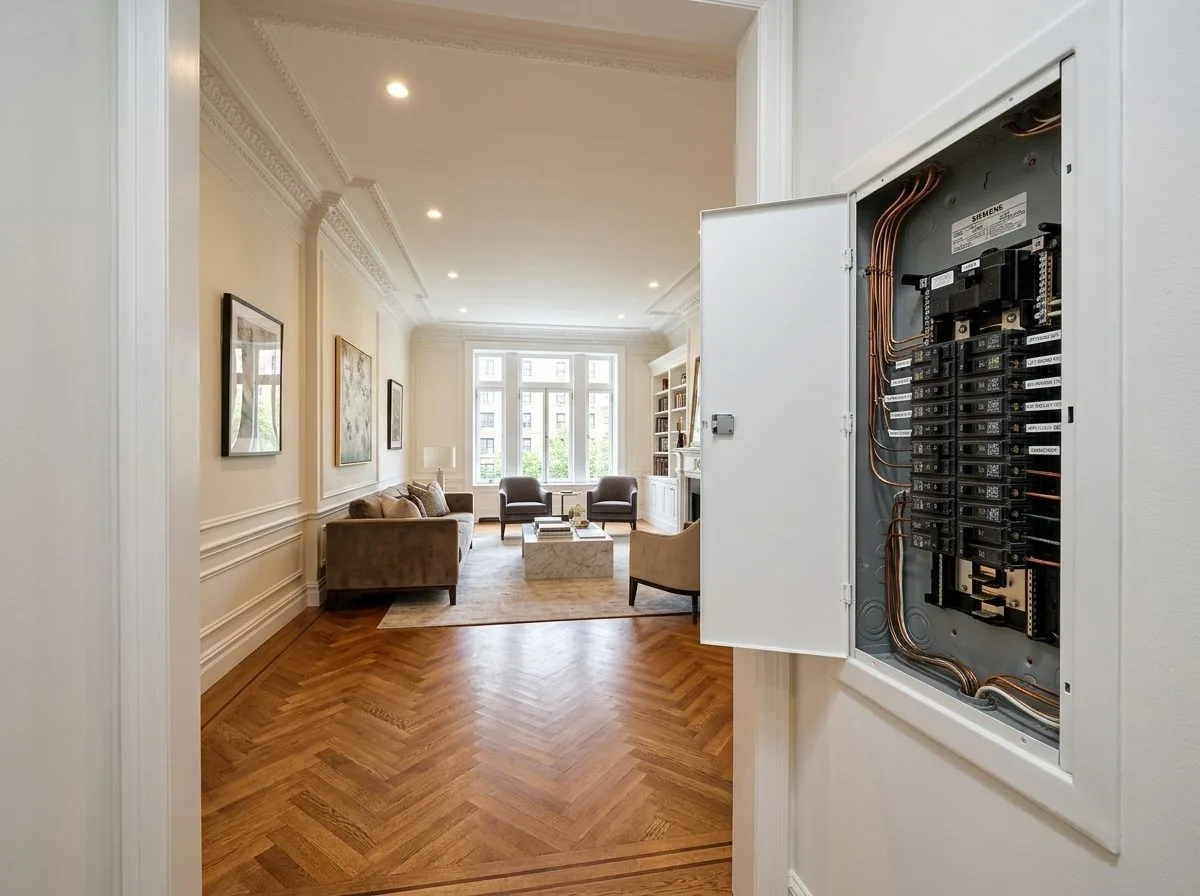
Owning an apartment or brownstone on the Upper West Side means living inside a piece of New York City architectural history. Prewar co-ops line Central Park West and Riverside Drive. Row houses fill the side streets. Glass condos stand in Lincoln Square. Each building type has its own wiring layout. This complete homeowner guide explains how apartment power systems work, why older circuits overload, and how to plan safe upgrades with a licensed electrician on the Upper West Side.
How Power Reaches an Upper West Side Apartment
Con Edison delivers electricity from underground street transformers into your building basement service room. Inside that locked cellar room, main service disconnects feed individual meters and vertical riser cables that climb through the floors to each apartment.
In a single family brownstone, one main meter and one main breaker panel control the entire house. In a multi family cooperative or condominium, your apartment breaker panel is actually a subpanel fed by the basement riser. That distinction matters for every renovation. Your max power depends on the basement riser wire size. It does not depend only on the metal box in your hall.
1. Electrical Panels and Service Capacity in Prewar Buildings
Apartments built before 1940 were designed when families used a few incandescent lamps, a radio, and a small refrigerator. Many unrenovated units still have 40 amp or 60 amp panels that hold only four to eight circuits. Some older walk ups still use round screw in glass fuses, while mid century renovations often installed Federal Pacific Stab-Lok or Zinsco breaker boxes that fail to trip during overloads.
Upgrading to a modern circuit breaker panel gives you reliable thermal magnetic trip protection, spaces for new dedicated lines, and arc fault protection. Read our detailed cluster guide on electrical panels in prewar NYC buildings and our breakdown of what affects the cost of a panel upgrade in NYC to learn how riser sizing and board rules work.
2. Old Branch Wiring Inside Plaster and Masonry Walls
Behind the plaster walls of prewar apartments, electricians in the 1910s through the 1940s pulled early flexible steel armored cable known as BX. Inside that spiral steel armor, the copper wires were wrapped in rubber and braided cotton cloth. Over eighty years of heat cycles, especially above hot ceiling light fixtures, that rubber and cloth insulation dries out and crumbles when touched.
Older BX cable also lacks a dedicated green or bare copper grounding wire. As a result, many bedrooms and living rooms still have ungrounded two prong outlets. Our cluster guide on old wiring in prewar apartments explains how cloth wiring, knob and tube runs in 1890s brownstones, and modern armored copper replacements compare.
3. Why Circuit Breakers Trip in Older Apartments
The most common call we receive every summer happens when a homeowner turns on a window air conditioner and the bedroom plus half the living room suddenly goes dark. In a typical prewar layout, a single 15 amp circuit feeds multiple rooms. A 15 amp circuit provides 1,800 watts of peak capacity and 1,440 watts of continuous capacity.
When a window air conditioner draws 1,000 watts on the same circuit as a television, computer, and bedroom lamps, plugging in a vacuum or hair dryer immediately pushes the current past 15 amps. In kitchens, sharing one circuit between a microwave and a toaster or espresso machine causes the same trip. Visit our troubleshooting guide on why breakers trip in old apartments to see how load balancing and dedicated appliance lines stop nuisance trips.
4. NYC Electrical Code Rules and DOB Permits for Apartment Owners
New York City does not use the standard suburban electrical rules found in other states. The NYC Department of Buildings enforces the NYC Electrical Code, which amends the National Electrical Code for dense fireproof and multi family structures. For example, plastic sheathed Romex cable is prohibited in most Manhattan apartment buildings. Electricians must use metal clad cable, armored cable, or metal conduit so conductors stay protected inside walls and ceilings.
The code also requires ground fault circuit interrupter protection in kitchens, bathrooms, laundry closets, and wet areas, plus arc fault protection on bedroom and living area branch circuits during renovations. Explore our full guide on the NYC Electrical Code for apartment owners to understand when DOB permits, GFCI outlets, and hardwired smoke detectors are required.
5. Lighting Design and Ceiling Types on the Upper West Side
Many Upper West Side apartments have no overhead ceiling fixture in the living room or bedrooms. Instead, a wall switch controls one half of a baseboard receptacle for a floor lamp. When homeowners want to add recessed LED lights or hang a dining room chandelier, ceiling construction determines what is possible.
Brownstones and many six story prewar buildings have wood joists above plaster lath, which allow recessed housings and expandable fan braces. Larger twelve to twenty story prewar buildings and post war towers along Riverside Boulevard often have poured concrete floor slabs. You cannot cut deep holes into structural concrete slabs. Instead, electricians build shallow ceiling soffits or use surface channels. Read our lighting guide for UWS apartments to learn about concrete ceiling options, fan rated boxes, and no neutral smart dimmers.
6. EV Charging and Backup Power in Co-ops and Brownstones
Electric vehicle ownership is growing fast across Manhattan, and condo and co-op boards are increasingly reviewing requests for Level 2 chargers in underground building garages. Installing a charger in a shared garage requires a load calculation, a metal conduit path from a basement distribution panel, and a submeter so the car owner reimburses the building for electricity used.
NYC fire codes ban gas generators inside apartments or on balconies. Quiet indoor UL 9540 battery units are the safe choice for apartments. Private brownstone owners can use standby units if yard clearances allow. Our guide on EV charging in NYC co-ops and board approval walks through submetering, load sharing, and board submittals.
7. Kitchen and Bathroom Remodel Electrical Planning
A modern Upper West Side kitchen renovation replaces a single shared circuit with six to eight dedicated lines. Today, the NYC code requires two 20 amp small appliance countertop circuits, plus dedicated feeds for the refrigerator, dishwasher, microwave, and range. Homeowners switching from gas stoves to electric induction cooktops must also check two technical details early: total apartment feeder amperage and 208 volt building voltage.
Most Manhattan apartment buildings supply 120/208 volt three phase power rather than 120/240 volt single phase power. Choosing an induction range or wall oven rated for 208 volts ensures fast boiling and baking performance. Read our kitchen remodel electrical guide for NYC co-ops before ordering appliances or cabinets.
8. Power Outages and Electrical Emergencies
Summer heat waves put heavy strain on underground street feeders and building switchgear. When your lights go out on a July evening, the first step is checking whether the outage affects the entire block, your building common hallways, or only your individual apartment. Sometimes only one leg of your 120/208 volt feeder blows a fuse in the basement, leaving half of your apartment outlets live and the other half dead.
Active warning signs such as a fishy burning plastic smell, visible sparks at a receptacle, or a hot breaker panel cover always require shutting off the circuit and calling a licensed electrician immediately. Keep our guide on what to do during a power outage on the UWS bookmarked for step by step checks.
How Co-op and Condo Alteration Agreements Work
Before you upgrade a panel or remodel a kitchen in a co-op or condo, the management office needs an alteration packet. That packet holds our license, a custom insurance certificate, a written scope, and a load sheet. The load sheet proves your new appliances fit within your feeder limit. Planning those documents early keeps your project on schedule from day one.
Planning an Electrical Repair or Renovation on the Upper West Side?
Our licensed electricians inspect prewar panels, trace apartment circuits, and prepare complete co-op board paperwork across the Upper West Side.
Explore Co-op and Condo Electrical Services or call PeakPower Upper West Side at (212) 555-0123.
Frequently Asked Question
The biggest limitation is usually the amperage of the vertical feeder cable rising from the basement Con Edison meter room to your apartment breaker panel. Many prewar units receive 40 to 60 amps, which requires careful load planning or a riser upgrade when adding high draw appliances.
Related Upper West Side Electrical Guides
Electrical Panels in Prewar NYC Buildings
Learn how fuse boxes, recalled panels, and basement risers work in UWS apartments.
Read ArticleOld Wiring in Prewar Apartments
See how cloth insulated BX cable and ungrounded outlets age inside prewar walls.
Read ArticleKitchen Remodel Electrical Guide for NYC Co-ops
Plan your countertop circuits, 208 volt appliances, and board load letters.
Read Article